Optimal house temperatures have a decisive influence on animal health and performance. For this reason, heating is indispensable in many climate zones. The goal is to maximise heat gain, optimise the heat supply to the animals and keep energy costs as low as possible.
Big Dutchman offers you various space or zone heating systems. These can run on gas, fuel oil or hot water.
JetMaster
Heaters with 100% heat gain using natural gas or propane
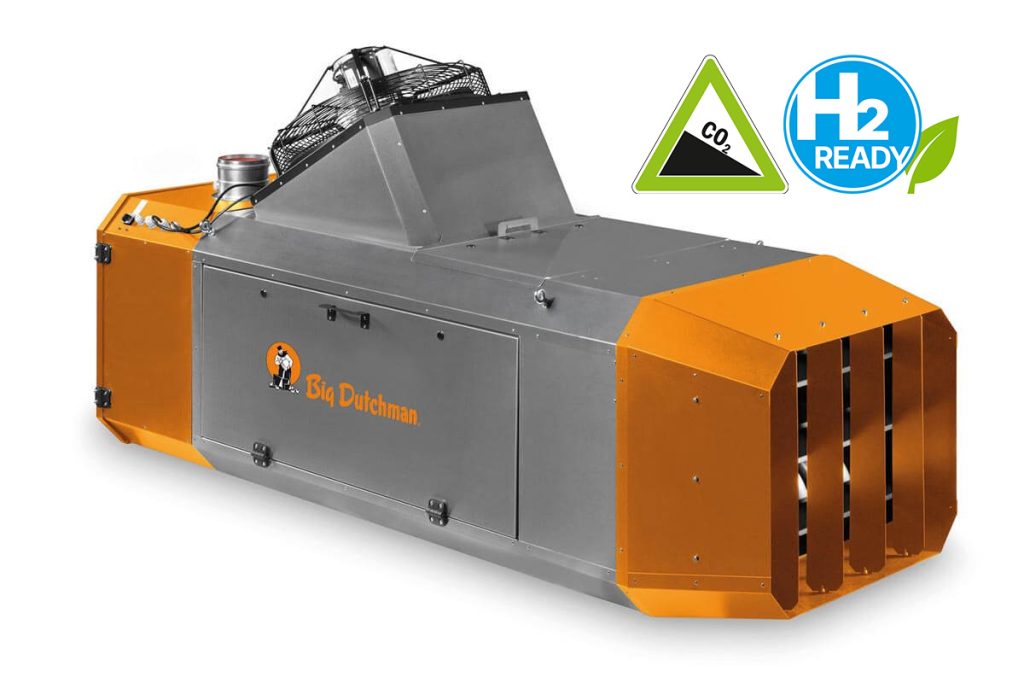
For many years, JetMaster has been among the proven heaters in the Big Dutchman range. Models are available that run on natural gas or propane, or on fuel oil, and are controlled by a thermostat. With flame control, the gas supply is cut off immediately if the appliance fails to ignite or the flame goes out.
The integrated, powerful fan ensures good distribution of the warm air throughout the house. The control unit provides information on the operating status of the heater.
Key advantages:
animals receive 100% of the heat generated →no heat losses;
no chimney connection required;
easy to install;
attractive price-performance ratio.
JetMaster with exhaust chimney
Heaters with indirect combustion and low energy consumption
The JetMaster with exhaust chimney can be supplied for operation with natural gas or propane, or with fuel oil. Thanks to the closed combustion chamber, the house air is free of carbon dioxide and other harmful gases, since these are discharged outside through a chimney. The integrated, powerful fan ensures good distribution of the warm air throughout the house.
With the JetMaster types DXC and RGA, the fresh air required for combustion is drawn in from outside through a double-wall chimney and preheated for a higher degree of efficiency.
Key advantages:
combustion gases in the house air are avoided;
the ventilation rate can be reduced;
a double-wall chimney increases efficiency;
open flame in the house is avoided.
Gas radiant heater
Direct heat supply to the animals
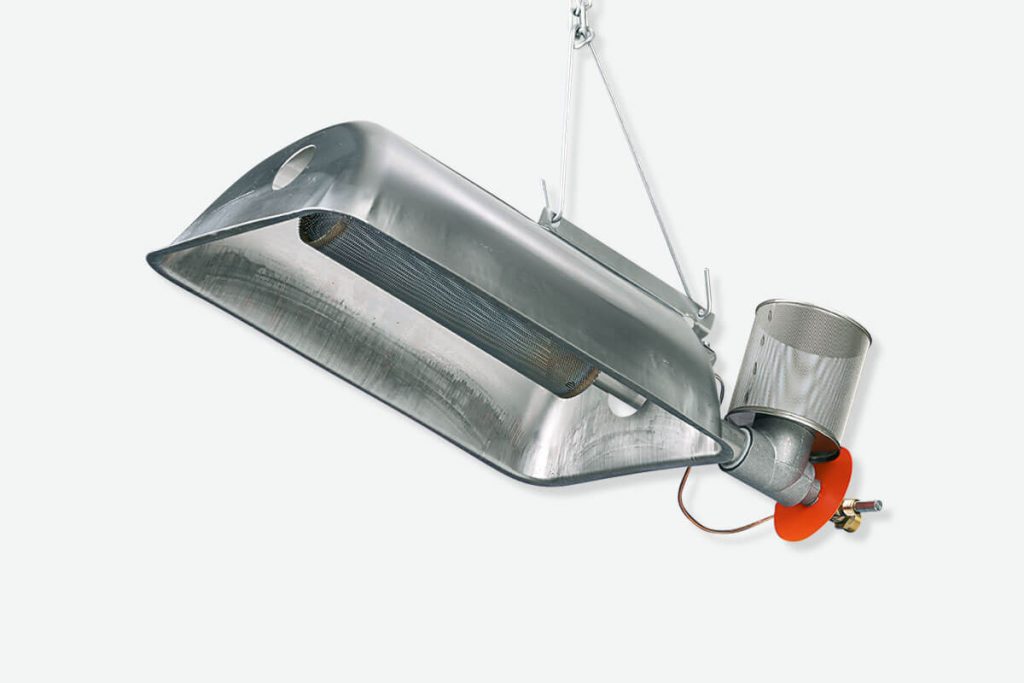
Gas radiant heaters are used when intense heat has to be supplied to animals on a limited area and for a defined period. An advantage of these gas heaters is that they require no electrical connection.
Convection heating
Hot-water radiators, future-oriented and sustainable
The trend towards hot-water heating continues. As open combustion is avoided, the CO2 content in the house air is significantly lower and air quality improves.
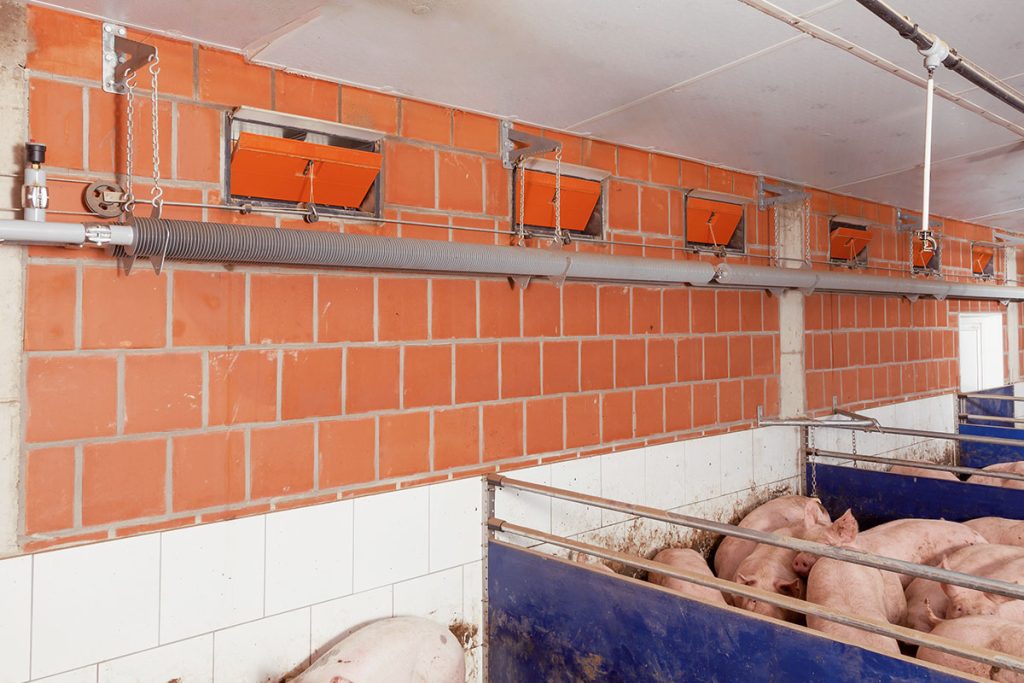
The aim is to maximise heat emission. This is achieved with a large-surface radiator. The radiators are mounted just below the air inlets in order to warm the incoming fresh air.
Renewable energy sources such as wood chips or straw pellets can be used to heat the water.
Delta pipe and Twin pipe
Ideal use with diffuse air inlet systems
The Delta and Twin pipes are perfectly suited for perforated ducts and DiffAir ceilings. They are made of aluminium and run on hot water, although only a small amount of water is needed.
Por su buena conductividad térmica (emisión de calor 180-200 vatios/m) aportan una constante temperatura espacial en la nave. También pueden instalarse como calefacción previa en el pasillo central.
The pipes are anodised for better protection against ammonia. They are light in weight and are supplied in different lengths, up to a maximum of 6 m. Installation is simple.
Radiant pipe
Hot-water pipe surrounded by spiral fins, large heat-emitting surface
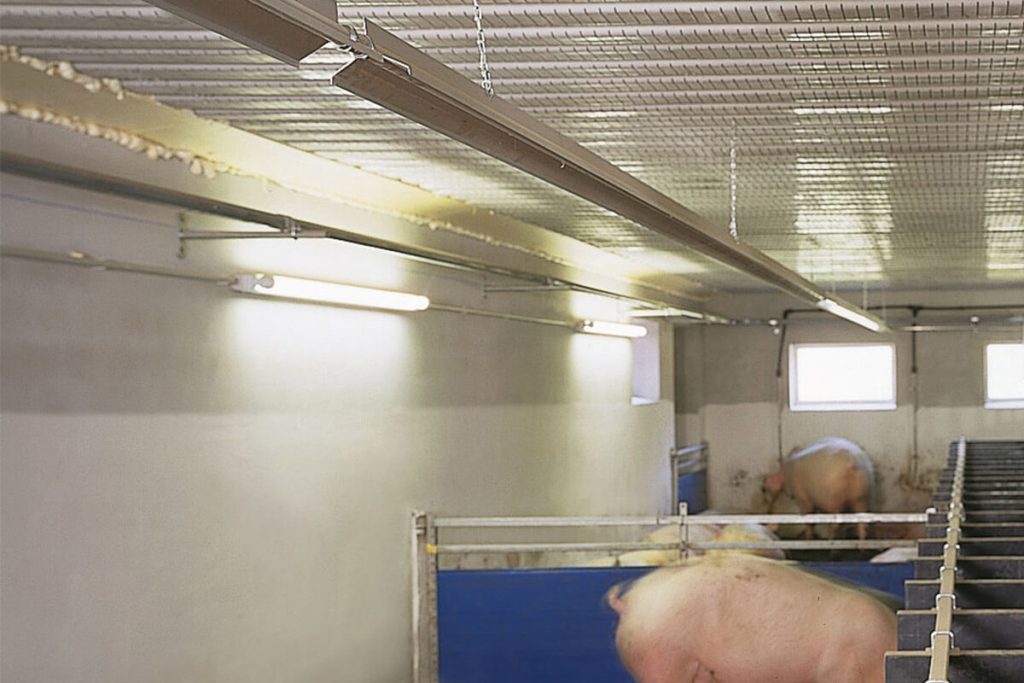
The Big Dutchman radiant pipe is made of galvanised iron or of aluminium with epoxy powder coating. Hot water is pumped through the pipe.
Las vueltas de la espiral (aletas o costillas) suman una gran superficie (1 m²/metro lineal). Entre estas aletas se desprende calor y se genera una fuerte región térmica. La distancia entre aletas está medida de forma que las partículas de polvo no puedan adherirse.
The pipes are fixed to the wall with brackets or suspended from the ceiling, if possible just below the air inlets, in order to warm the incoming air. The automatic air bleeding (also on the Delta pipe and Twin pipe) ensures high heating reliability.
potencia calefacción hasta 600 vatios/metro lineal;
requires little space;
low weight (aluminium);
simple and quick installation.
HeatMaster
Low-consumption water-to-air heat exchanger
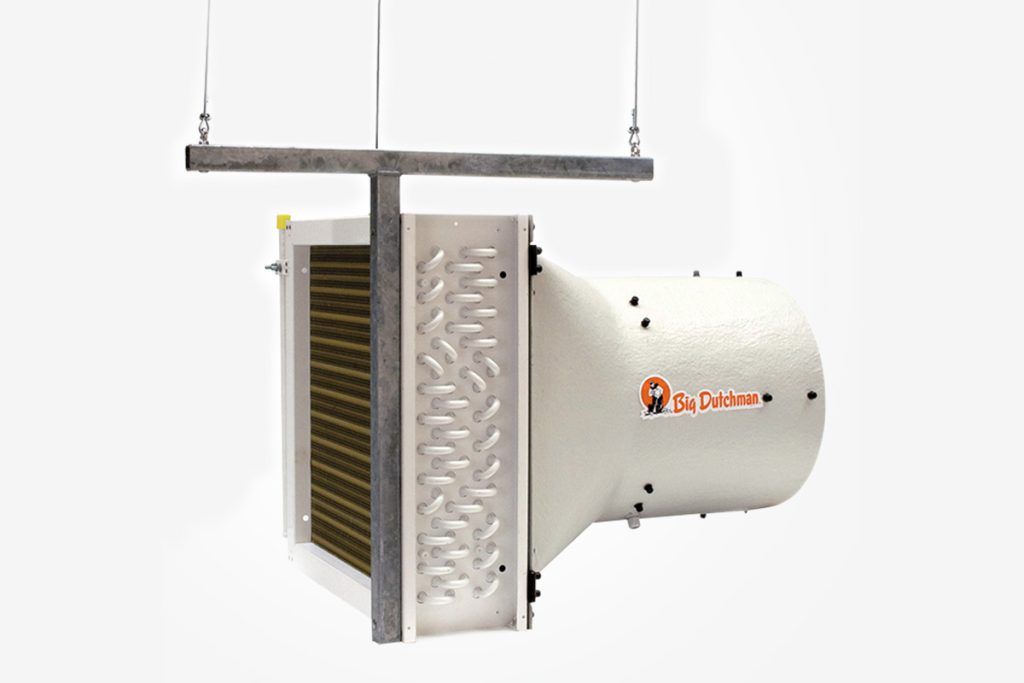
The HeatMaster of the H series are hung laterally at the height of the air inlets, or can be fixed with a wall bracket. They basically consist of a stainless-steel finned frame and a fan.
They are easy to clean with a high-pressure cleaner and are corrosion-resistant. The integrated, powerful fan ensures good distribution of the warm air throughout the house.
Key advantages:
combustion gases in the house air are avoided;
a wide variety of fuels can be used;
there is no open flame in the house.
Zone heating
Ideal for use in weaning rooms
Piglets need a lot of heat, especially in the first days after transfer, to get through the critical weaning phase well. A temperature of approx. 32 °C in the resting area would be optimal.
Alongside the usual space heating for weaning houses, hot-water zone heating is gaining importance. It consists of a cover placed at a height of 70–80 cm above the slatted floor. The size of the cover depends on the number of animals and the size of the pen.
A rim of about 20 cm at the front of the cover creates a heat pocket. The heating (Twin pipe) is located just below it. With this system, the piglets' resting area in particular is heated, while lower temperatures are sufficient in the rest of the compartment. This reduces heating costs.
Plant BIG DUTCHMAN Mexico
Plant BIG DUTCHMAN Brazil
Personal Details:
Download the datasheet
Complete your details to access the PDF with the product's technical specifications.